Within seafood, packaging not only determines how a product looks, but how it performs. In shelf life, logistics, shelf impact and ultimately in margin.
For retailers, private label partners, and packaging specialists, the choice between a flow-wrap, a stand-up pouch, or a cardboard box is not solely a technical consideration – it's a commercial and operational decision.
Klaas Puul always develops packaging solutions in conjunction with the product, the supply chain, and the market. That makes the difference between a good product and a successful product.
Overview of packaging formats for shrimp and seafood
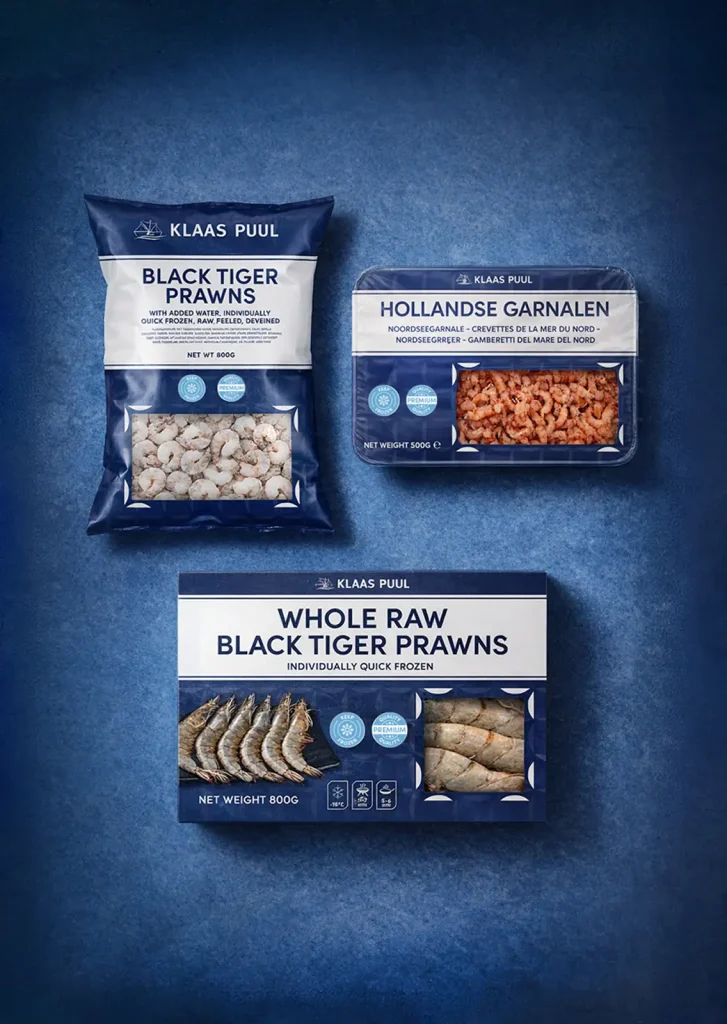
Within Klaas Puul's product range, three main sizes are used:
Flow-pack (100g – 2.5kg)
The standard in efficiency and scalability within seafood packaging.
Sta-zak / stand-up pouch (200g – 1kg)
Developed for premium positioning and consumer convenience.
Cardboard packaging (200g – 500g)
Strong in sustainability and brand presentation, with growing relevance in retail.
Each format has its own role — and its own impact on the chain.
Shelf-life and product protection
Shelf-life is, in seafood, directly linked to packaging technology and material choice.
Flow-pack: maximum protection and consistent shelf life
Flow-pack packaging, often combined with MAP (Modified Atmosphere Packaging), offers a stable and controlled environment.
Advantages
- Longer shelf life
- protection against dehydration and oxidation
- consistent product quality
This makes flow-pack particularly suitable for high-volume retail and international distribution.
Sta-zak: balance between protection and ease of use
Sta-zakken combineer barrière-eigenschappen met functionaliteit.
Advantages
- Good protection with the right choice of materials
- reclosability (less waste for consumers)
- suitable for premium and convenience segments
Cardboard packaging: dependent on inner packaging
Cardboard is almost always combined with an inner liner (e.g. plastic film).
Advantages
- Protection dependent on inner layer
- less direct contact with external influences
- suitable for frozen products with lower turnover
At Klaas Puul, the optimal combination of packaging and technology to ensure quality is determined on a per-product basis.
Merchandising and shelf presentation in retail
Packaging is often the first point of contact with the consumer – and therefore decisive for conversion.
Sta-zak: maximum visibility and premium appeal
- stands upright on the shelf
- large front-facing surface for branding
- strong visual differentiation
Ideal for private label premium seafood and value-added products.
Cardboard: storytelling and sustainability as drivers
- space for brand story and origin communication
- strong perception of sustainability
- Distinctive in the freezer compartment
Cardboard packaging is playing an increasing role in premium private label strategies.
Flow-pack: functional and efficient
- less visual impact
- strong in price communication and volume sales
- Ideal for standardised shelving
Within the right segment, flow-pack remains commercially very effective.
Supply chain and logistics efficiency
The impact of packaging on the supply chain is often underestimated — but it directly influences costs and delivery reliability.
Flow-wrap: optimal for scale and efficiency
- high packaging speed
- efficient palletisation
- lower transport costs per unit
Flow-pack is the most cost-effective solution for large-scale distribution.
Sta-zak: more volume, more air
- lower stackability
- higher transport costs per unit
- Sea freight in logistics
Suitable when brand value outweighs logistical efficiency.
Cardboard: stable and logistically reliable
- good stackability
- Protection during transport
- suitable for mixed pallets
A strong choice for retail that prioritises sustainability without logistical compromises.
Cost structure and commercial impact
Packaging directly impacts the cost price — but indirectly also the selling price and margin.
Indicative impact per format:
- Flow-pack
Lowest packaging costs, highest efficiency → strong in price-competitive segments - Stay safe
Higher costs, but higher consumer perception → suitable for premium positioning - Cardboard
Average costs, strong brand and sustainability value → balance between price and perception
The right choice is rarely purely cost-driven. It's about total value creation in the chain.
How do you choose the right packaging format?
The optimal choice arises from a combination of factors:
- Target audience and price segment
- Rotational speed and shelf-life requirements
- logistics structure and distribution model
- Brand strategy and positioning
- Sustainability objectives
Klaas Puul supports this consideration with practical experience, data, and chain insights — not as an external consultant, but as a partner who helps build the end result.
From packaging to performance
Packaging must do more than protect. It must contribute to rotation, brand value, and supply chain efficiency.
This calls for choices that go beyond material or format alone.
Klaas Puul brings product, packaging, and supply chain together in one controlled process — with the aim of creating premium seafood that is not only good, but also demonstrably performs better in the market.
Klaas Puul as a packaging partner in seafood
- in-depth expertise in seafood packaging and product development
- integrated approach from sourcing to shelf
- Focus on quality, shelf life, and presentation.
- flexible solutions for retail, foodservice and industry
- proven track record in private label seafood
From concept to shelf. Carefully developed. Reliably delivered.